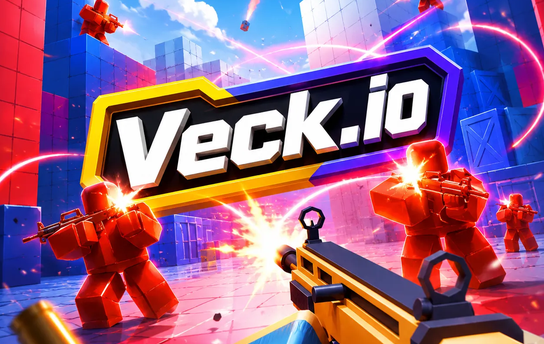
I knew almost immediately that Veck.io was going to expose one of my bad gaming habits.
I rush.I do it in shooters all the time. I see an enemy, get excited, forget that cover exists, and charge forward as if I’m about to become the hero of the match. Sometimes it works beautifully. More often, I end up staring at a defeat screen wondering why I thought that was a good idea. Veck.io punished that habit pretty effectively.
At first, I thought I was simply bad at the game. My aim wasn’t terrible, but I was losing fights constantly. I’d get the first shot, start feeling confident, and then somehow end up eliminated a second later. After enough matches, I realized the problem wasn’t really my aim.
It was everything I was doing before I pulled the trigger. That’s what makes Veck.io more interesting than it looks at first. On the surface, it’s an accessible browser FPS. You load into a multiplayer match, choose your equipment, move around the map, and try to eliminate the other players. The game has a substantial selection of weapons and multiple ways to play, including Free-for-All, team battles, 1v1 encounters, and Gun Game-style matches.
You can understand the basic idea almost immediately. Getting good at it is another matter. My first piece of advice for new players is to stop worrying about winning. I know, that sounds strange in a competitive shooter. But if you’re new, your first few matches should be about learning. Learn how fast your character moves. Learn how the weapons behave. Notice how quickly opponents can appear from different directions. Pay attention to the areas where you keep getting caught.
You don’t need a great score yet. You need information. Once I started treating my deaths as information instead of simply bad luck, I improved much faster. If I died while crossing an open section of the map, I knew I needed a safer route. If I lost a close-range fight with a long-range weapon, I knew I had chosen the wrong engagement. If I kept getting surprised from the same direction, I knew I wasn’t paying enough attention to the map.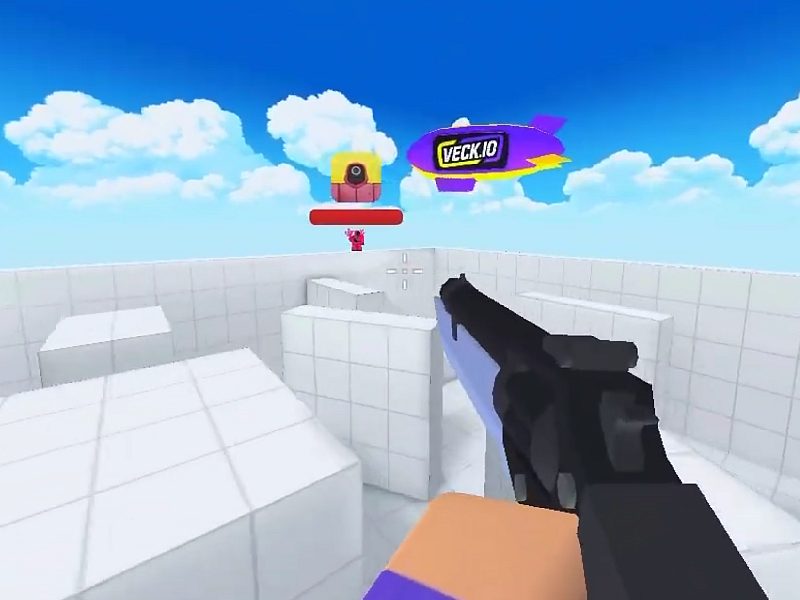
It sounds basic. But you’d be amazed how often players ignore these things.
The weapon system gives you plenty of opportunities to experiment. Veck.io features a wide selection of weapons, including assault rifles, shotguns, snipers, launchers, melee weapons, and more.
I wouldn’t recommend picking weapons randomly once you’re serious about improving. Think about what you want to accomplish.
If you like close-range fights, use equipment that supports that style. If you’re more patient, a sniper or longer-range weapon may suit you better. If you prefer flexibility, stick with something that can handle different situations without forcing you into one specific playstyle.
And don’t assume the weapon you like most is always the weapon you should use.
That’s another lesson I learned the hard way.
Sometimes you need to adapt to the map rather than forcing the map to suit your favorite weapon.
The movement system adds another layer to this. Jumping, sliding, and dodging give you more options during fights, and learning to use them naturally makes a noticeable difference. (play.google.com)
When I started, I treated movement as something separate from aiming.
That was a mistake.
Good movement and good aiming have to work together. If you’re trying to dodge an opponent while completely losing control of your own aim, you’re not really gaining anything. The goal is to make yourself difficult to hit without turning yourself into a worse shooter.
Once I understood that, fights became much more interesting.
I started thinking about movement before the fight instead of panicking halfway through it.
That also helped me understand why positioning matters so much.
You don’t always need to take the first shot.
Sometimes you need to wait.
If an opponent is moving toward you and doesn’t know you’re there, you already have an advantage. Why throw that away by revealing yourself too early? Likewise, if you’ve taken damage and the situation isn’t favorable, there is nothing wrong with backing away and finding a better position.
I used to think retreating meant I was losing.
Now I think of it as resetting the fight.
That mindset made a huge difference.
The different game modes are useful for developing different skills, too. Free-for-All is chaotic and forces you to pay attention to multiple directions. Team battles are better for learning how to work around other players and understand larger engagements. 1v1 is brutally honest because you can’t blame your teammates when something goes wrong. Gun Game is useful for learning how to adapt when you can’t rely on one familiar weapon.
I’d actually recommend playing modes you aren’t comfortable with.
It’s easy to become good at one specific situation.
It’s much harder to become a flexible player.
And that’s where experienced Veck.io players have an advantage. Once you’ve played enough matches, you start recognizing situations before they happen. You know where someone is likely to appear. You understand when a player is trying to lure you into chasing them. You can tell when you’re about to walk into an unfavorable fight.
That kind of awareness doesn’t come from a tutorial.
You earn it by making mistakes.
Lots of them.
For me, that was the most satisfying part of playing Veck.io. I could actually feel the difference between my first session and later ones. I wasn’t suddenly amazing, but I was making fewer stupid decisions. I wasn’t rushing into every fight. I was checking my surroundings. I was choosing weapons more carefully.
The game didn’t change.
I did.
That’s usually when I know I’ve found a game worth spending more time with.
There are still things I’d like to see improved. More maps, additional modes, continued weapon balancing, and regular content updates would all help keep the experience fresh for dedicated players. Browser shooters can become repetitive if the core arenas and strategies stay unchanged for too long, so continued development will be important.
But I don’t think Veck.io needs to become dramatically more complicated.
Its biggest strength is actually its accessibility.
You can open the game and start playing quickly, but you can also spend a lot of time refining your skills if that’s what you want. Casual players can enjoy a few matches, while competitive players can start worrying about positioning, weapon matchups, movement, and map control.
That range is valuable.
So, would I recommend Veck.io?
Yes.
But I’d give new players one warning: don’t judge it too quickly.
Your first matches might be messy. You might get eliminated by players who seem impossibly fast. You might wonder where you’re supposed to go or why your shots aren’t landing. That’s normal.
Give yourself time to learn.
Once you stop treating every death as a failure and start treating it as a lesson, the game becomes much more rewarding.
I started Veck.io thinking I needed better aim.
What I actually needed was patience.
I needed to stop rushing.
I needed to look around before pulling the trigger.
And, honestly, I needed to accept that sometimes the smartest move in a shooter is simply not taking the fight.
That’s what I like about Veck.io now. It doesn’t just reward fast reactions. The better you understand the game, the more you realize that the best players aren’t necessarily the ones shooting first.
They’re the ones who already know what they’re going to do before the shooting starts.
And I’m still trying to become one of them.