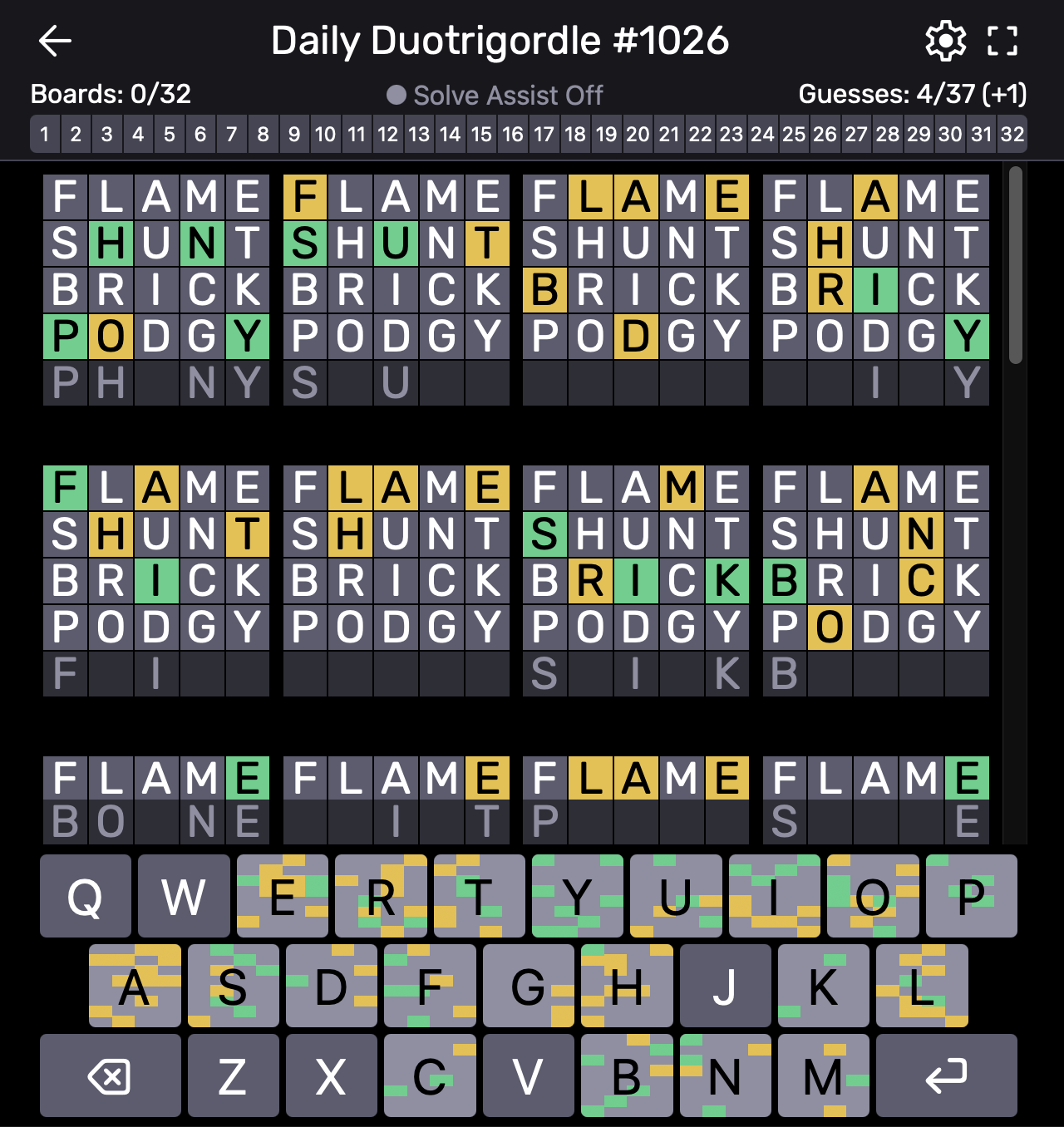
I had a tidy little word-game routine before Duotrigordle appeared. One puzzle with breakfast, maybe another during lunch, and that was enough. Then somebody suggested a game where I could solve 32 five-letter words at once. You can also try it at https://duotrigordle.io
I laughed. Then I tried it. Now my old routine is gone.
Duotrigordle is a browser-based word puzzle that expands the Wordle format to an almost comical size. Every word you submit is tested against 32 hidden answers simultaneously, producing green, yellow, and gray clues across a large grid. In the standard game, you have 37 guesses to solve all 32 boards.
The numbers make Duotrigordle sound crueler than it really is. Each guess collects information across the entire puzzle, so your opening words can reveal dozens of useful letters at once. As answers begin falling into place, one correct word often provides the missing clue for several others. The game moves from confusion to momentum, then ends with a tense search for whichever strange five-letter word has survived the cleanup.
It’s excessive. It’s also remarkably well designed.
From Visual Clutter to Controlled Chaos
I care a lot about clean game design, and my first reaction to Duotrigordle wasn’t positive. Thirty-two boards create an enormous amount of visual information. You need to scroll, compare patterns, and remember where you saw that nearly completed word a moment ago.
The interface begins making more sense once you understand the job it needs to perform. Each board follows the same clue system, and solved puzzles can be hidden to reduce clutter. Wide Mode adjusts the board layout for desktop displays, while empty rows can be collapsed to make better use of the screen.
The official Duotrigordle website also includes input hints, a colorblind setting, optional animation controls, statistics, historic puzzles, leaderboards, and several game variations. There’s even a speedrun timer for people who look at 32 simultaneous word puzzles and think the real problem is that they aren’t happening quickly enough.
On a desktop or laptop, the overall design works well. On a phone, the experience requires more patience. The site can be installed as a web app and played offline, which is convenient, but no display setting can completely remove the challenge of fitting so many boards onto a narrow screen.
My First Game Went Wrong in a Very Predictable Way
I began with a couple of sensible words, revealed plenty of common letters, and felt unusually confident. Then I found one board that appeared close to completion and became determined to solve it.
That was the mistake.
I spent multiple guesses working through similar answers while 31 other puzzles waited nearby. By the time I escaped that one stubborn word, my spare guesses were nearly gone. I had treated Duotrigordle like a regular Wordle with some distracting decorations around it.
The better strategy is almost the opposite. When a board has too many possible answers, leave it alone. Solve the words supported by stronger evidence, and let those answers test more letters across the grid. The uncertain puzzle may resolve itself later without costing an exploratory guess.
New players should remember that Duotrigordle gives you only five guesses beyond the minimum required to enter 32 correct answers. If you use three opening words for broad letter coverage, you have roughly two moves left for mistakes or deliberate testing. That margin is small enough to matter but large enough to reward a careful plan.
A Practical Duotrigordle Strategy
Begin with two or three words containing common, mostly unique letters. You want useful vowels and frequent consonants, not an exhibition of obscure Scrabble knowledge. Early guesses should reveal information across many boards.
After that, scan for answers with clear patterns. A board containing four confirmed green letters may look attractive, but check whether the missing letter has several possibilities. Something like “_ATCH” can be dangerous because many valid words fit. A less complete board may actually have only one logical answer after its gray letters are considered.
Whenever you solve a word, notice which letters it tests elsewhere. If two answers are equally certain, enter the one containing letters that remain unclear on more boards. That small habit improves the value of guesses you already need to make.
You should also count the unfinished boards against your remaining attempts. If ten puzzles remain and the game shows twelve guesses left, you have only two flexible moves. Don’t spend one casually.
Honestly, this simple count prevents more failures than any clever opening word.
Repeated letters deserve special care. A pattern may look impossible because you’re unconsciously assuming that every letter appears once. Try placing a confirmed letter in another position, and inspect how multiple copies were colored in earlier guesses.
The game’s input hints can help here. Ghost letters preserve known green positions during entry, while inconsistency warnings point out guesses that ignore confirmed clues. These tools are enabled by default and make Duotrigordle more manageable without revealing answers.
Why Practice Mode Is Worth Your Time
The Daily Duotrigordle creates a pleasant sense of occasion, but it isn’t the best place to learn. Losing because you tested a questionable strategy can feel annoying when you must wait until tomorrow for another official puzzle.
Practice Mode lets you experiment. Try different opening combinations, compare two-word and three-word setups, or deliberately leave ambiguous boards until later. You’ll begin recognizing when you have enough information to stop exploring and start solving.
Regular players can use practice games to improve speed. Develop a consistent scanning pattern instead of moving randomly around the page. Check boards in the same order, identify certain answers, and enter several in succession. Hiding completed boards makes this easier because the puzzle gradually shrinks with your progress.
I’d avoid chasing speed until your completion rate is reliable. Fast scrolling can create the illusion of expertise while you overlook a green letter and waste a guess. Accuracy builds good habits. Speed comes later.
The Alternate Modes Change More Than Expected
Daily Sequence reveals only one board at a time and provides 39 guesses. This eliminates the standard strategy of abandoning a difficult word and working elsewhere. You must solve the current board before seeing the next one, so ambiguous patterns become much more threatening.
Daily Jumble chooses the first three words for you and allows 38 attempts. I prefer this mode when my normal opening begins feeling automatic. It forces me to work with imperfect or unfamiliar information rather than repeating a memorized routine.
Perfect Challenge requires 32 solutions in exactly 32 guesses, although your first submitted word is automatically correct. From that point onward, every guess must solve a board. It’s an elegant challenge for experts and a wonderfully efficient way for beginners to discover that they are not experts yet.
Historic Duotrigordle puzzles provide additional daily-style games, while accounts support game history and leaderboard features. Private leaderboards can turn the puzzle into a low-key competition among friends, assuming everyone agrees not to become unbearable about completion times.
Duotrigordle’s Biggest Strength and Weakness
The game’s scale is responsible for both.
Thirty-two boards create strategy that smaller Wordle variants can’t reproduce. You constantly decide which answer to enter, which puzzle to postpone, and how to extract maximum value from limited guesses. A word solved on one side of the page can unlock another far away.
That same scale creates friction. Scrolling becomes tiring, especially on mobile. The interface can feel crowded, and the final stage sometimes involves entering answers you have already identified rather than making new deductions.
Solve Assist can automate boards whose solutions are fully deducible, reducing that mechanical cleanup. I understand the appeal, though I prefer entering answers manually because finishing each board is part of the reward.
The daily format may also become time-consuming. Duotrigordle isn’t the puzzle I open when I’m standing in a queue that might move at any second. It deserves a proper seat and a few uninterrupted minutes.
Is Duotrigordle Worth Playing?
Duotrigordle is absolutely worth trying if standard Wordle no no longer provides enough challenge. It keeps the accessible color-clue system but adds meaningful decisions about priority, efficiency, and risk. Beginners can learn the rules immediately, while dedicated players have several modes, statistics, archives, leaderboards, and speed goals to explore.
The design isn’t effortless, particularly on small screens, and the sheer number of boards will overwhelm some players. That’s fine. Duotrigordle isn’t trying to become the quickest word game in everyone’s morning routine.
It wants to be the main event.
I still play ordinary Wordle. I enjoy its restraint and the satisfying neatness of one puzzle completed in a few minutes. But when I want a word game that demands more attention, Duotrigordle is the one I open.
Anyway, breakfast can wait. Board 27 has four green letters, and I need to know what that missing consonant is.